
Finding Jewish Meaning in Music: Interview with Dr. Stephen Daniel Arnoff
Adapted from Dr. Arnoff’s appearance in Jewish Actually hosted by Lila Newman.
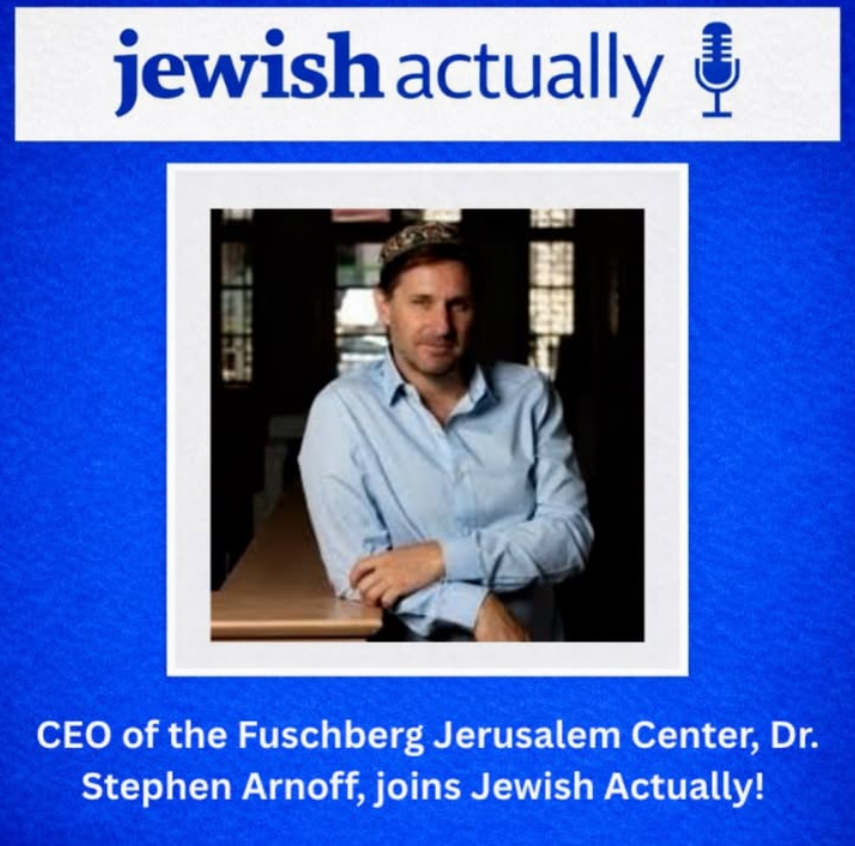
Q: Can you tell us a bit about your Jewish upbringing and influences?
Dr. Arnoff:
It’s funny you ask me that– I’m working on a second book right now which is meant to be a spiritual memoir, so I’m thinking a lot about how it came to be that I was deeply, unequivocally, fully bored and disenteres in Judaism until I was in my early twenties. How is it possible that this is the field I’ve been in now for quite a few decades? I think my way in that I was drawn to music and literature and spirituality. I was a humanities person. The world of ideas really lit me up. There were a lot of curiosities that I had in me but it took me a long time for to understand that maybe there was a bit of me in all of these different ways of expressing myself- which led to me to start studying Judaism. And I never really looked back.
I wanted to bring Jewish ideas to life both deep, textually, but also wide, not isolated from the great ideas of the world.
Q: You talk a lot about music—is that something you’ve always wanted to do, even before the Judaism?
Dr. Arnoff:
I grew up with a lot of music in the air. That’s another important part of waht I write and think about- how music influences us in so many ways. I’m actually just at the first anniversary of the death of my father, and one of the ways that I’ve been celebrating him has been thinking about the music we had in the house growing up. I realized that Bruce Springsteen was the most played artist in our house growing up. Then the Beatles “White” album. Then Carly Simon. And figuring out what all of that rock-and-roll did to me has been an interesting trick.
I am a big fan and follower of Bob Dylan and his spiritual wisdom. For me- it’s about finding ways to make meaning in the world and music is a primary way that people (especially myself) do that. It ties into the work I do as a writer and teacher. I’m interested in the way we interpret the world through creativity. It’s a technology that’s been available to every religious tradition, Judaism has a specific take on it as well.
Q: Did serving in the IDF influence your sense of Jewish identity and responsibility?
Dr. Arnoff:
I think that one of the reasons why people move to israel at a formative age is theres a sense of being grounded in something and a sense of purpose for taking on responsibility. Young people who are thinking “well, I’m now being asked to adult. What’s the purpose? What will I become and why?”
Coming to isrel is a quadruple dose of all that at once. The idea that it’s still a society that still has a collective ethos where people do things together and there’s a lot of collective responsibility, young people take on a ton of responsibility and are charged with the work of protecting the country. I wanted to join the collective ethos. It was very challenging but I’m glad I did what I did. There are prices to pay for sure.
Q: How do you become involved in your Jewish work?
Dr. Arnoff:
The steps were accidental. I was in Israel trying to make a living as a musician. I was part of a community called Elul which at the time the focus was on secular and religious people studying together, that was a big issues in the 90’s and Elul was a pioneering instutituion. Everyone who studied there had to do a final project and my final project turned into a mini rock song about what we were studying. I raised a little money to make a production and then I got a bunch of money from an Israeli television station to prouce some videos and it just grew.
I got into this idea of doing rock and roll that was inspird by sacred texts. I went to study sacred text called Midrash and still had to make a living so I started working and put together groups of artists that would make music together and I climbed the ladder of Jewish communal life. Bringing creativity to something traditional has always been really important to me. I stayed with that field and tried to help grow it.
Q: How does your Midrash study impact how you teach it today?
Dr. Arnoff:
The whole thing with Midrash is even the most sacred things still leave us with questions. Even if you believe the Torah came down from the heavens, the sages for thousands of years have said “yes, but” and continued to ask questions. There’s a midrashic point of view that lends itself to asking questions. They need to do more than preserve tradition—they need to support creativity. I allow myself license to not only think about exodus from an imaginative point of view but also relate it to Bob Dylan and Carly Simon, etc. The point being that when you bring a midrashic imagination to the table you’re saying there are arts and sages and prophets who bring out sentences
All of the work that I do has a Midrash vibe. Uou can love and respect something that’s holy, and still have something important to ask or say about it. I’m an antifundamentalist. I believe the fundamental of religion is where the sacred meets the real, so that’s how my studies impact my work.
Q: Why are the arts such a powerful way to engage jewish ideas?
Dr. Arnoff:
First of all becasue arts are powerful. Art well done can make life worth living. Art poorly done can make you want to disappear. There’s nothing more annoying than terrible art. In terms of the power, the power is that human beings are able to access something beyond themselves through their skills in the arts. Whatever kind of art that is. This is the hand of god, so it only makes sense to find ways to use the arts to heighten the experiences of spiritual life. To do what normal life can’t- to ritualize it, to codify it, to challenge it. Arts come to an age-old tradition and give us a means to challenge and heighten what Judaism does. It’s what the sages and rabbis and mystics have always done. It’s about respecting the content and challenging the content. Pushing against the content and raising it up. It should be all those things. And art has so much time and muscle behind it because it’s one of the most ancient ways of people expressing themselves, so it’s just a natural fit. Art created the sistine chapel and art created the illumnated bibles and so much more.
Now we don’t live in an age where (in the secular west) religious forces patronize the arts. Artists sort of have to serve the myth. Arts are free, so artists need to make a living on their own and make meaning on their own as well. It’s mythic and huge and amazing. It’s actually kind of new that we have a thing where people make art that isn’t connected to relgion.
Q: What’s one piece of advice you’d give to young Jews?
Dr. Arnoff:
A couple of bits of general advice come to mind. Slow down. Be grateful. Ask questions, respectfully. And I say respectfully not because I don’t think people shouldn’t shout or protest but be able to actually ask questions in a respectful way to find graciousness and gratitude. Gratitude is the essence of being a spiritual person, I think. And we all just need to slow it down. It takes time to gain wisdom, you can’t just take a pill for it. ChatGPT gets me close to wisdom all the time- but never quite there.
Q: If someone listening feels disconnected from Jewish life, where would you tell them to start?
Dr. Arnoff:
I think it’s a balance between being safe and taking risk. I feel very safe reading, so I started my journey reading. I really didn’t want to talkto anyone who was a rabbi or a sage because I didn’t trust it. I didn’t trust the authorities. I’m a man, but I didn’t trust the patriarchical system that’s dominated by machismo and men, I just didn’t trust it. I grew up in a feminist home.
It took me along time of reading and thinking before I was able to engage with so-called authorities of religion. One of the tricky things here is that the most loving, engaged Jewish expression out there is Chabad. I have a lot of love and appreciation for Chabad. The generosity and the kindness. But it is a fundamentalist ideology which doesn’t jive with my egalitarian beliefs. I am fundamentally egalitarian and believe men and women should have equal access to tradition.
One could also just start with the tradition and dive in. But you need to be careful to not leave yourself behind when you dive in and end up becoming a shell of you. Your seeking self is important, don’t leave it behind. And to ease up on these things, reading good books, asking people what they read, having a good sense of questioning and really leaning in. I’ve seen it many times where people come into the Jewish tradition after not being engaged with it and it’s really overwhelming.
As sure as you are that you’ve found the asnwer, be humble. It’s true if you’re sure that you found your answer in “Free Palestine.” It’s true if you found your anser in “I’m gonna do Shabbat the way my Chabad rabbi does Shabbat.” There’s no extreme that is the full you. The only exreme is that there is no one like you. The only extreme beyond that is that there is no one who is greater than anybody else, and no one ultimately has the answer. You gotta stay humble and stay questioning. I believe that diversity is power. You become wise by being sustained by diversity and a real ecosystem of different opinions and experiences. And humility.
Listen to the Full Episode
You can hear the full conversation on Jewish Actually.